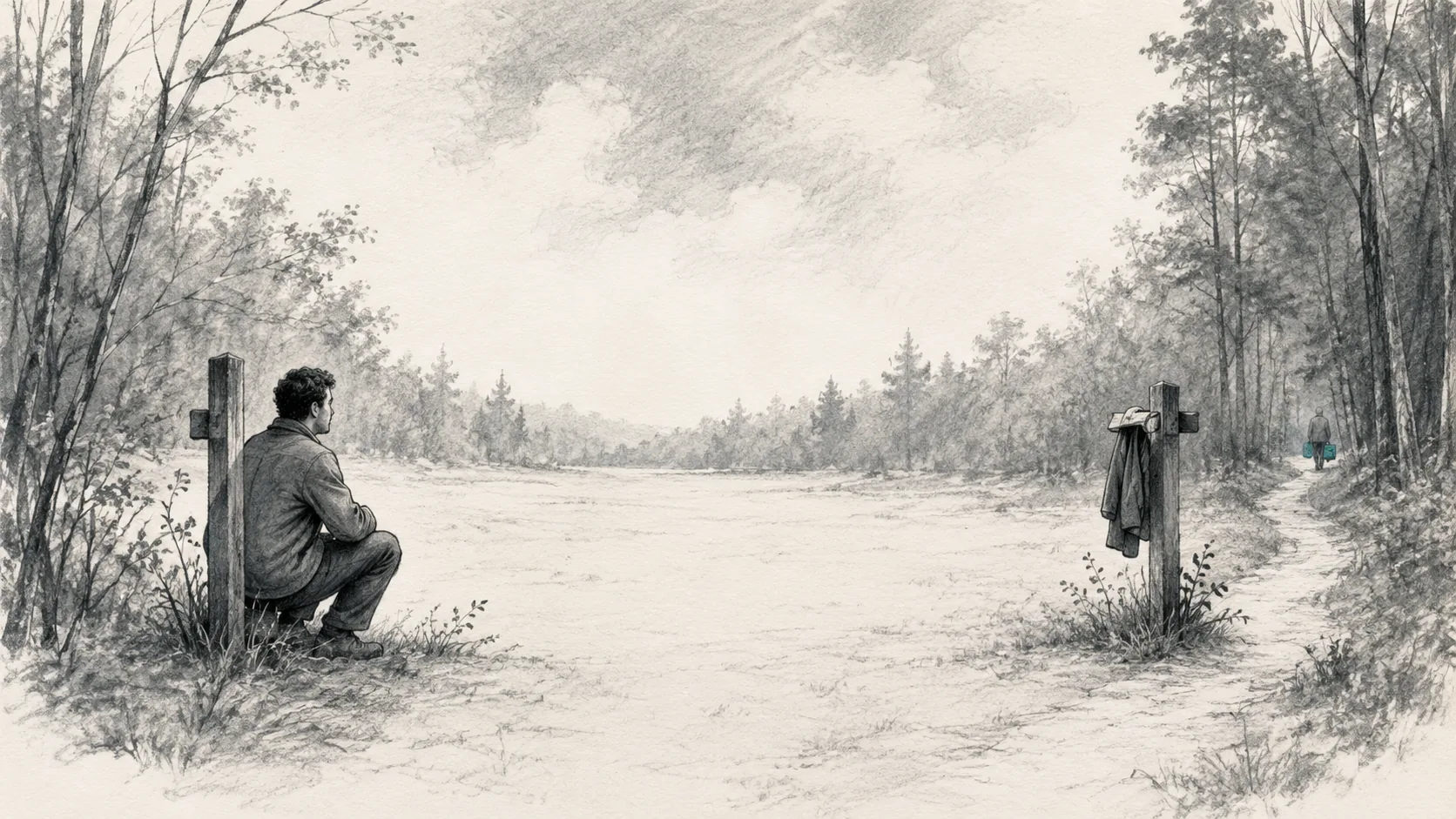
We rarely give up on what we wanted outright. We do something quieter: we shrink it until it no longer needs anyone else.
We do it without announcing it. We stop waiting, lower the stakes, take the sure thing, and tell ourselves later that we were only being realistic. From the outside it can look like wisdom. From the inside it usually feels like relief. And in place of what might have grown between two people, there is now something smaller, but also safer: something we can secure on our own.
Two hunters and a smaller catch
Rousseau gives us a brief scene. Two hunters can bring down a stag only if both hold their posts. A hare passes within reach; either hunter can leave, secure the smaller meal alone, and end the shared hunt. Game theory later formalized this as a coordination problem: the safer individual outcome set against the better outcome that depends on mutual confidence.
The hare is not contemptible, and the model is not a diagnosis of relationships. It cannot tell us why a person stayed, left, trusted, or withdrew. I use it only to make one tension visible: what I can secure alone versus what we can build only if both of us accept uncertainty. The analogy begins there and should not be asked to prove more.
That tension appears in a marriage, a friendship, a business partnership, a team. We say we want the stag. When the hour comes to hold the position, some of us go after the hare and call it prudence.
The problem is not that we want too little
It is tempting to explain all this by saying people have lowered their standards, that no one wants commitment anymore, that we simply prefer what is easy. I think that reading is false. Almost everyone I know wants something deep: a relationship that lasts, a team they can rely on, a friendship that survives disagreement. The wanting is not what is missing.
What is missing is the willingness to stay exposed long enough. Building something large with another person requires an interval in which you have already given something and still do not know whether the other will give it back. That gap, uncertain and without guarantees, is precisely what many of us cannot tolerate. We do not abandon the stag because we stopped wanting it. We abandon it because waiting for it, unsure, is the part that hurts.
The hare rarely presents itself as cowardice. It wears disguises. Sometimes it is control: I would rather set the terms alone than negotiate them with you. Sometimes it is emotional distance, or an independence announced as a virtue. Sometimes it is irony, which lets us say something we mean while keeping the option to claim we did not. Sometimes it is a studied ambiguity, defining nothing so we can lose nothing. And sometimes it arrives afterward, in the sentence that quietly cancels everything: it was never that serious anyway.
The scene changes; the mechanism does not. In a couple, it is the person who keeps one foot outside the door and calls it not rushing things. Among friends, it is the one who is present while everything is easy and gone the moment something real is asked of them. At work, it is the partner who wants the benefits of a real partnership while keeping a private exit ready in case it fails, or the founder who talks about the team and quietly makes sure the thing that matters depends on them alone. And in leadership, it is the person who asks everyone else for commitment while shielding themselves from the shared consequences.
I have chased the hare too. I have called my retreat prudence, my fear clarity, and my refusal to owe anyone anything independence. It is easy to recognize the hare when someone else is chasing it; harder when we are the ones carrying it.
A fair distinction is needed here, because it is easy to make all autonomy suspect. Healthy independence is real and worth protecting: being all right on your own, not clinging to another out of fear of the emptiness, choosing the bond without making it a lifeline. That kind of independence is what makes the stag possible; it does not stand in its way. Defensive self-sufficiency is a different thing. It is not the capacity to be alone but the decision to need no one, so as never to be at anyone’s mercy.
The difference is not always visible from the outside, and not always from the inside either. Both can use the same vocabulary: freedom, judgment, not depending on anyone. But one leaves the door open and moves toward the other without urgency; the other locks the door in advance and calls that maturity.
A stag is caught by two
The hardest thing about the stag is not wanting it. It is that it cannot be hunted alone, no matter how much will one person brings. I can decide to trust, to wait, to take the risk; if the other does not do the same at the same time, my willingness is not enough. The vulnerability that allows us to build something does not consist of one person exposing themselves while the other remains safe. It only produces something shared when both accept the risk.
That requires several things at once. Timing: both people have to remain exposed long enough for cooperation to have a chance to pay off. Reciprocity: if one keeps giving and the other only receives, trust eventually runs out. And constancy, not declarations, because trust is not announced once; it is renewed through small decisions over far more time than we would like.
This is why the first move is so expensive. Someone has to expose themselves before there is any proof the other will follow. There are things we can only learn after we begin taking the risk: whether the other person will move too, whether they will hold their side, whether what appeared to be shared truly was. There is no version in which both people wait in perfect safety until a guarantee appears. Going first secures nothing; it may bring reciprocity, useful information, or evidence that the other person was not holding their position. When each person insists that the other move first, nothing moves, and both keep their perfectly reasonable-sounding explanations intact.
Here is the quietest trap. Mistrust tends to confirm itself. If I suspect you will go after the hare, I go first, so as not to be left empty-handed. My retreat then gives you a reason to retreat, and each of us ends up proving what we already believed: that the other could not be counted on. No one lied, and yet the stag was lost. The prophecy came true because each person acted to avoid being the only one still trusting.
None of this makes the safe choice always wrong. Some experiences teach us, with good reason, that waiting can be costly. Whoever was once the only one who held the post learns not to do it twice. Choosing the hare can be prudent, understandable, at times necessary. But it helps not to confuse an understandable defense with a decision that costs nothing. Every time I take the hare, I am also rehearsing a way of being with other people, and rehearsals become habits.
The one left alone in the forest
There is a figure in this story almost no one talks about, and it is the one that interests me most. It is not the person who went after the hare. It is the one who stayed.
Someone held their position. They kept betting on the large thing, the shared thing, the outcome that only existed if both of them held on. They assumed there was someone on the other side of the clearing doing the same. And at some point, without warning, they discovered they were alone, still holding up something no one else was holding anymore.
The asymmetry is cruel in its simplicity. The person who left has their hare: something modest, but real, in hand. The person who stayed has the empty forest and the hunger of what never came. They did not lose through naivety. They were left with nothing because they kept holding a bet that, without warning, was no longer shared.
That is a specific kind of grief, different from ordinary heartbreak. It is not only that someone left; it is that you kept building a house the other person had already stopped living in. You go on speaking in the plural for a while after the other person has quietly returned to the singular. When you finally understand, you do not only lose the future you were counting on; you revisit every recent gesture and begin to wonder how long you had already been alone without knowing it.
For a while, the one who stayed does not even call it being left. They call it patience. They tell themselves the other is busy, or frightened, or working up to it, and they hold the position a little longer on the strength of that story. Some of the steadiest loyalty in the world is spent exactly this way, quietly, on someone who has already gone. The cruelty is that the loyalty was real; it was simply aimed at a shared thing that had become, without announcement, a thing for one.
What makes it hard to talk about is that nothing dramatic happened. There was no betrayal loud enough to name, no single scene to point at, only the slow discovery that the whole weight had shifted onto one set of shoulders while the language of togetherness stayed in place. That is why the person left behind so often ends up apologizing for noticing, as if wanting the shared thing to actually be shared were the unreasonable part.
The hardest part is what the experience leaves behind. Whoever is left alone in the forest enough times learns the lesson that impoverishes everyone: next time, leave first. That is how you manufacture the people who no longer wait for anyone. They were not born distrustful. They went hungry too many times while guarding something that was supposed to be shared, and they decided never to be the last one holding it again.
I am not writing this to hand out blame. The person who went after the hare almost never did it out of malice; often they did it out of fear, or because they, too, had been left waiting once and swore they would not be again. Understanding that matters. But understanding does not dissolve the consequence. Someone stayed, and waited, and that waiting had a cost the other never had to see.
The question that remains
That is why I think the usual question is badly put. We tend to ask whether we want something deep, whether we want a real relationship, a real team, a partnership worth having. And almost all of us answer yes, and mean it. The wanting is sincere, and it settles nothing.
The more honest question is different: can I sustain the risk of building it with someone else? Not whether I desire it, but whether I can tolerate the interval in which I have already exposed myself and still do not know what the other will do. Almost everything is decided in that interval, and it is exactly there that the hare always looks more reasonable than it is.
This does not mean you should always hunt the stag. Some positions are not worth holding, and some waits are no longer justified; sometimes the hare is simply the wise choice. The question is not whether we can hold out forever, but whether we can tell old fear from present evidence: whether we are fleeing out of habit or responding to what the other person is actually doing.
Because it is not about staying forever. It is about not walking away by reflex from something two people are still holding. The difficult part is telling one from the other: the unavoidable discomfort of trusting and the evidence that reciprocity has already ended.
In the end, the hare is not the problem. The problem is choosing it by reflex and calling that realism. If we genuinely want something larger, in love, friendship, work, or anywhere else another person is required, the task is not to want more. It is to tolerate the uncertain stretch in which we have already taken the risk and still do not know what the other person will do, without running before we discover whether, this time, someone on the other side is still holding their part.
Key takeaway. Almost no one fails for wanting too little. We settle for the smaller thing we can secure alone because we cannot tolerate the interval in which we have already exposed ourselves and still do not know what the other will do. The real question is not whether we want something deep, but whether we can sustain the risk of building it with someone else instead of chasing the first certainty that wanders within reach.
Source notes
Sources are listed in the order the article uses them. The formal model belongs to game theory; its application to relationships and teams is this article’s interpretation, not an established result.
- Jean-Jacques Rousseau, A Discourse Upon the Origin and the Foundation of the Inequality Among Mankind (1755). The stag-and-hare scene in Part II is the origin of the image used throughout. It is paraphrased here, not quoted, and read as a parable about cooperation and defection rather than as a claim about the state of nature. Source: Project Gutenberg edition.
- Brian Skyrms, The Stag Hunt and the Evolution of Social Structure (Cambridge University Press, 2003). The modern game-theoretic treatment that frames the stag hunt as a model of trust, risk, and cooperation, and separates the safe outcome from the cooperative one. Used here as a conceptual lens, not as empirical evidence about human relationships. Source: Cambridge University Press.
Discuss this article
Thoughtful comments, corrections, and notes from real-world practice are welcome. Discussion is managed through GitHub.
This space is intended for meaningful technical discussion, useful corrections, and field experience. Spam, personal attacks, low-effort comments, and vendor pitches may be removed.