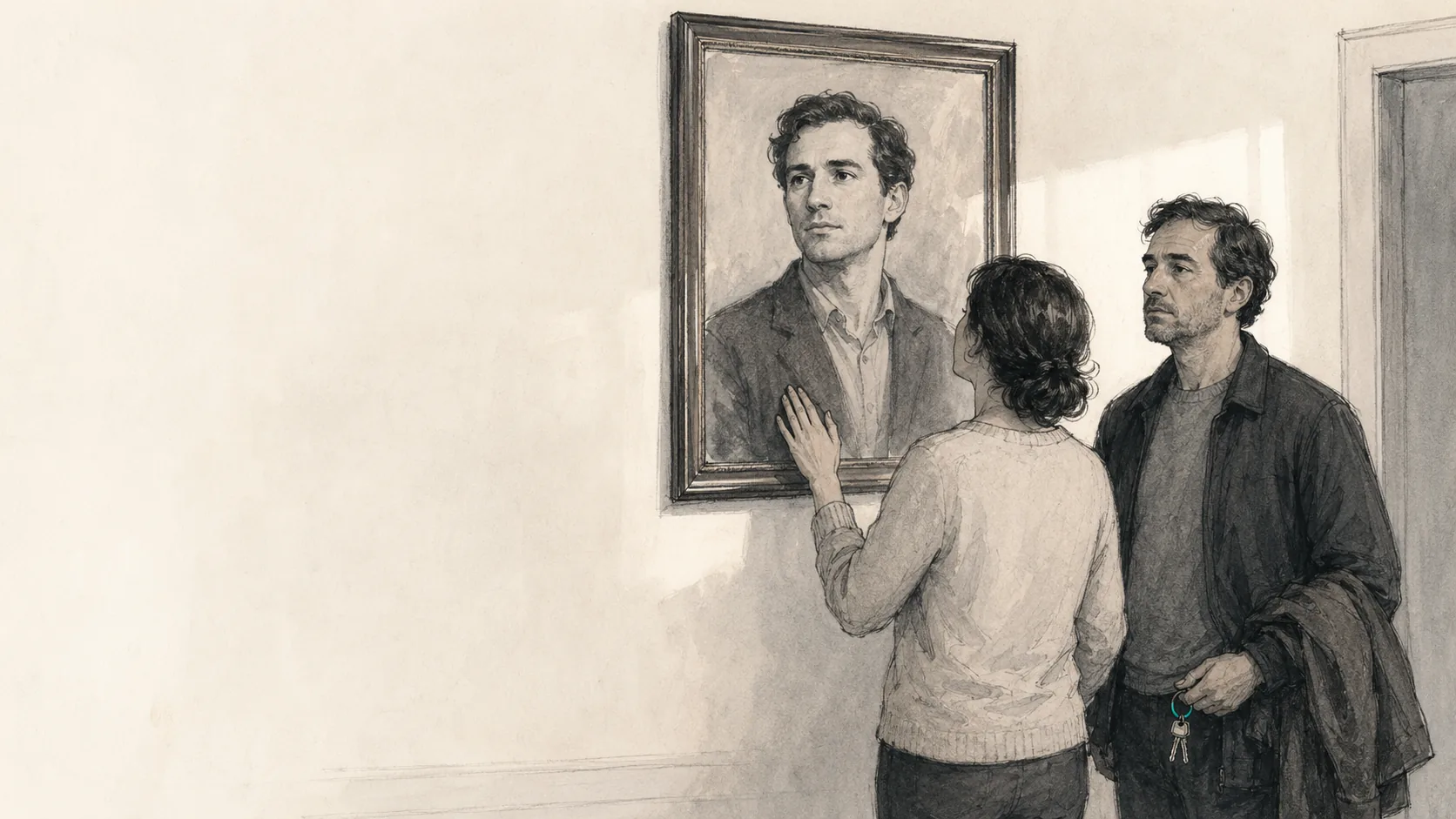
Before we ever learned to be authentic, most of us learned to be legible.
Kahlil Gibran opens The Madman with a scene that stays with you. A man wakes up and finds that his seven masks have been stolen. He runs through the streets, face uncovered. People point, call him mad, back away. Sunlight touches his bare face for the first time in years, and something in him shifts: he no longer wants the masks. He blesses the thief.
You do not need to read the book to know the scene. Nearly all of us have lived a smaller version of it: a moment when the public version of ourselves fell off, and we stood in the middle of the world without the protection we had taken for granted. The first reaction is to run and pick it up. The second, if we can bear it, is to ask why.
The theft that looks like a loss
Gibran’s scene works because it exposes an asymmetry we all recognize. We tend our masks with more discipline than we spend examining why we wear them. We make sure they are in place before a meeting, a difficult call, a family dinner, a job interview. We check them the way we check a tie. We rarely stop, after enough years, to ask what face is underneath.
Losing them all at once feels like standing outside without a coat. In a sense we are: without the mediation we had prepared, other people’s gaze arrives without a filter. What happens in the hours after decides, for many, the shape of the rest of an adult life. Either we hurry to build a new mask fitted to the moment, or we stand still long enough to discover what remains when we are not putting on a face.
A mask is not always a lie
Before we canonize the bare face, defend the mask. Not every presentation is dishonesty. Professionalism is a mask. Courtesy is a mask. The prudence you carry into a hostile client meeting, a board conversation, a team in crisis: also masks. They are tools, not deceptions. They let us work with people we do not know, in situations we do not control, without exposing every nerve.
A mask does more than conceal; it also composes. It selects some features, leaves others out, and offers the world a stable face that is easier to recognize than the whole person. Its illusion does not always come from showing something false, but from presenting a selection as if it were the whole. The danger begins when others forget the difference and deepens when we forget it too.
The problem is not wearing them. It is forgetting we have them on. A mask that becomes skin stops being an instrument and becomes a sentence. We no longer put it on in the morning; it puts us on. And when someone finally sees us without it, we do not recognize the reflection.
That is the first silent cost of a well-run life: outer consistency is paid for in inner estrangement.
When society calls madness what it cannot classify
Organizations are not so different from that crowd: they too prefer legible identities. Titles, LinkedIn profiles, personal brands, internal reputations, annual reviews – all push in the same direction: be one thing, be that thing always, be that thing even after you have changed.
What does not fit a label gets uncomfortable. The architect who also writes, the executive who also doubts, the engineer who also paints, the leader who asks for silence instead of results one afternoon. None of that is madness. It is simply something that does not fit. And what does not fit gets labeled quickly: scattered, unfocused, “unclear where they’re going.”
Here I am using “madness” only as the crowd’s label in Gibran’s scene, not as clinical language. In this essay, the label names a social warning: stop being hard to classify. It should not be used to trivialize mental illness or to treat every experience of misrecognition as the same.
A good reputation can turn into a mask, too
In professional life, few masks are as hard to set down as a good reputation.
A bad reputation limits. A good reputation limits too, only with better manners. Being “the one who always solves it,” “the reliable one,” “the strategist,” “the calm voice,” “the deep technical mind,” “the strong leader,” “the creative,” “the adult in the room” opens doors. It also closes others without anyone noticing.
At first, that reputation feels like recognition. Then it becomes expectation. Later, if we are not paying attention, it becomes a debt.
The organization does not just remember what you did. It starts to claim it as a contract. If you held the system together through a crisis, everyone may now assume you can hold any crisis. If you translated chaos for leadership once, every hard conversation may now end on your calendar. If you never showed fatigue, your fatigue may become invisible by design.
The mask works so well it stops looking like a mask.
This is one of the less-discussed costs of professional growth: the more clearly useful you become to others, the harder it can be to change without looking inconsistent. The person once rewarded for solving fast can be punished for asking slower questions. The one recognized for execution can look less valuable when they start thinking in systems. The one admired for always being available can look less committed when they learn to protect their attention.
There is not always malice in that reaction. Often it is inertia. People organize their expectations around what has worked for them. If one version of you solved their problems, they will prefer that version to remain in stock. Someone else’s evolution is rarely convenient for the people who benefited from the earlier version.
That is why a mature reputation needs limits. Being known for something is not enough; the harder work is preserving the right to stop being only that.
The question is not whether a professional mask serves you. Of course it does. The harder question is this: are you still wearing it, or is it already wearing you?
The prison of being too well understood
Outside work, the same dynamic becomes more intimate. Being understood is not always a gift. Sometimes it is a well-appointed cage.
When someone believes they understand us completely, they begin to expect, without saying so, that we remain the version their interpretation requires. This is not always malicious. A stable idea of another person helps organize expectations, decisions, and affection. Revising it has a cost. It is easier to ask the other person not to change.
In a close relationship, that expectation can present itself as knowledge: “I know who you are.” The sentence may hold years of attention and care. It can also freeze a version of us in place. Sometimes we come home to find a portrait of ourselves, carefully preserved, that no longer matches the face we brought through the door.
The same pattern appears in teams, in mentors who “discovered” us, and in managers who learned to trust only one facet of our work. The intensity changes, but the mechanism does not: an interpretation that once recognized us begins to limit what we are still allowed to become.
Being understood can be a form of intimacy. It can also be a form of ownership.
Choosing the face again
In the original scene, what turns the story is not the loss of the masks. It is the moment the sun touches the bare face. That detail is worth carrying into the present.
Sunlight here is not a symbol of mystical illumination. It is anything that touches us without asking for a presentation: work done alone, an honest conversation nobody is watching, a decision made without an audience, an hour where we are not responsible for how anyone will interpret us. A space where no one is building, in real time, the biography that will be told about us later.
That contact is what reveals that the mask was heavy. Not while we were wearing it, but now, when it is gone. Many people with successful careers discover this late, almost always by accident: an illness, a forced sabbatical, an exit from a company, a move abroad, the end of a relationship, a loss. Only when the audience disappears do they notice how much invisible work went into holding the image up.
Freedom, at that point, does not arrive as expansion; it arrives as relief.
Here is where essays about authenticity often trip. Losing a mask does not make anyone real; it only opens room. We can live with less legibility, or build a new mask and call it truth: curated vulnerability, a polished “unfiltered self,” oddness turned into a brand, doubts published with the same discipline once used for certainties.
Those presentations are not contemptible. The old risk remains: believing we are no longer presenting anything. Maturity is knowing when we are wearing a mask, choosing which ones serve, and refusing to confuse changing one with taking them all off.
The underlying question is not whether we are understood. The question is who we have handed the right to define us, and how much of our life we have organized around that concession. Being understood by everyone is an expensive aspiration. It is paid for in malleability, in predictability, in a biography short enough to fit on a business card. Being understood by a few, the ones who matter, and staying slightly illegible to the rest, is another thing. It is more uncomfortable. It is also more livable.
Bless, then, the thief who takes the masks we were no longer choosing. Not because bareness is a virtue, but because, without them, we finally get to decide again what we want to show, to whom, and why. That decision, made new each morning, is the closest thing a face has to freedom.
Key takeaway. Freedom is not about becoming unreadable to everyone; it is about refusing to give everyone the right to define us. A mask can protect us, but when we stop choosing it and start obeying it, it no longer supports our life: it manages it for us.
Source notes
- Kahlil Gibran, “The Madman: His Parables and Poems” (Alfred A. Knopf, 1918). The opening prologue, “How I Became a Madman,” is the anchor image for this article. Used as a symbolic detonator, not as literary analysis. Source: Project Gutenberg edition of the 1918 Knopf text.
- Erving Goffman, “The Presentation of Self in Everyday Life” (Anchor Books, 1959). Origin of the “front” concept: the ordinary social mediation this article calls a mask.
- Carl G. Jung, “Two Essays on Analytical Psychology,” Collected Works Vol. 7 (Princeton University Press, 1966; German essays 1912 and 1928). Source of the concept of the persona, and of the warning about what it costs to identify with it.
- Charles Horton Cooley, “Human Nature and the Social Order” (Charles Scribner’s Sons, 1902). Introduces the “looking-glass self”: we see ourselves through how we imagine others see us.
Discuss this article
Thoughtful comments, corrections, and notes from real-world practice are welcome. Discussion is managed through GitHub.
This space is intended for meaningful technical discussion, useful corrections, and field experience. Spam, personal attacks, low-effort comments, and vendor pitches may be removed.