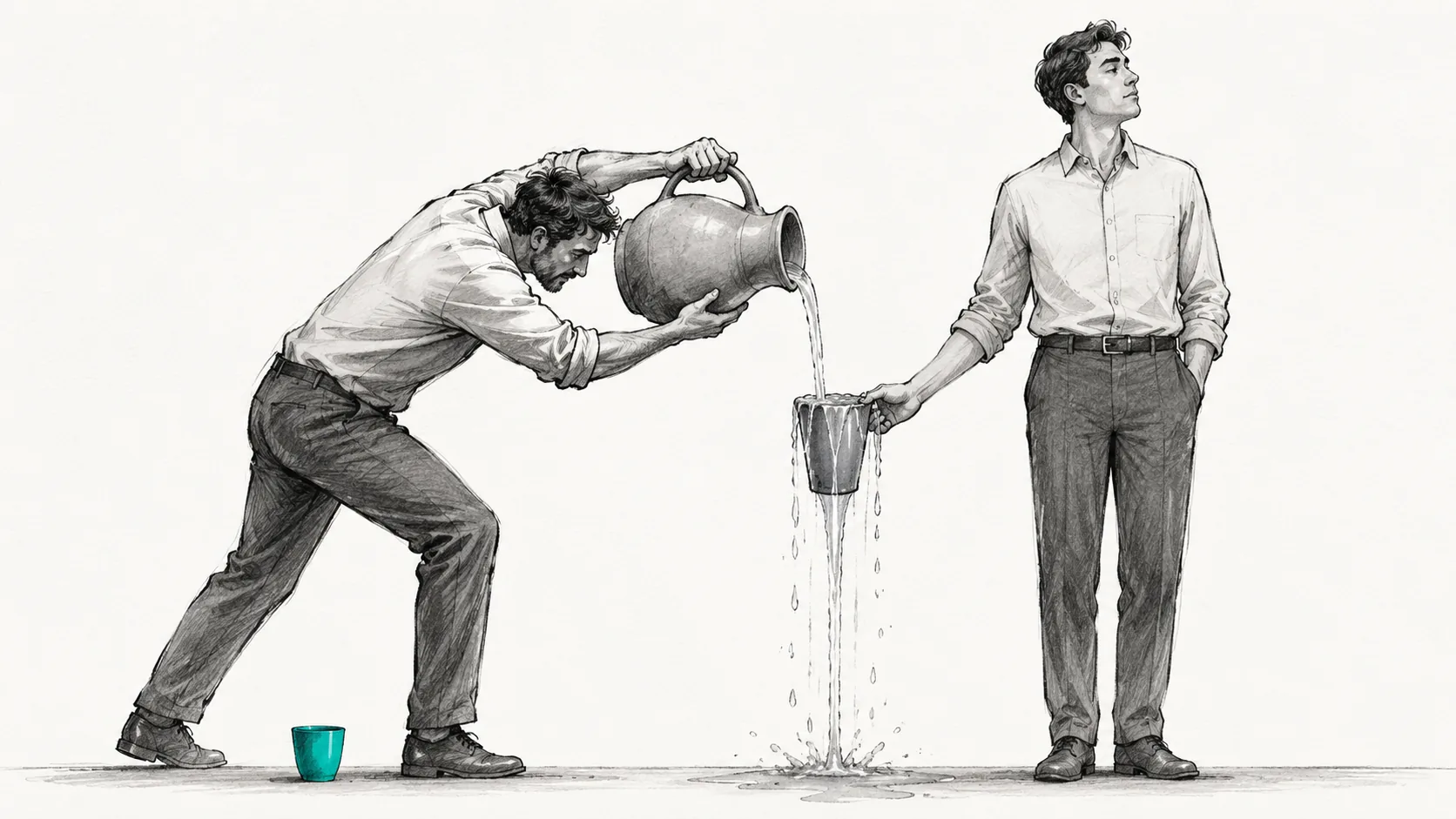
There is a scene many people recognize, even if they only found the words years later.
You helped, you showed up, you gave more than anyone asked for, and for a while, it felt like closeness. Then something shifted; the person you had helped the most did not treat you better, but worse.
It is an uncomfortable paradox, because it contradicts what many of us were taught as children: that giving brings people closer, that generosity earns affection, that the person who offers the most is the person most likely to be loved. But anyone who has spent years as the friend who always shows up, the partner who keeps forgiving, the family member who holds everyone together, or the employee who quietly covers for everyone else knows the other side of that story. Giving without limit does not always build love; sometimes it only builds availability, and availability, sooner or later, stops being thanked and starts being expected.
The uncomfortable question is why.
The gift is never just a gift
Marcel Mauss studied exchange systems in which gifts carried obligations to give, receive, and reciprocate. His account does not make every private gift a hidden contract. It gives me a narrower lens: a gift can create a bond, and receiving can carry weight even when neither person names it. What that weight becomes depends on the relationship; reciprocity, recognition, gratitude, or nothing at all are possibilities, not facts I can read from the receiver’s mind.
This does not make generosity false; it only removes its innocence. Giving does not end when something changes hands; it opens a relationship. Every relationship, even the warmest one, carries weight.
When that weight is small and occasional, it can settle on its own. A favor between friends, a loan repaid, a call at a bad moment – the balance may right itself without anyone having to discuss it. Trouble can begin when giving stops being occasional and becomes constant, when one person gives so much, so often, for so long, that reciprocity feels impossible. The generosity has not changed; the way each person experiences it may have.
Receiving honestly can ask for humility to admit help was needed, effort to give something back, and honesty about a debt that cannot always be repaid in the same currency. But I cannot know from the outside which of those feelings another person carries, if any.
One possible response to unpayable weight is a shortcut: instead of carrying the debt, reduce the value of what was received.
That can happen in two ways. The gift is devalued: perhaps it was not that generous, anyone would have done it, it cost the giver little. Or the giver is devalued: perhaps they are naive, seeking approval, too predictable in their kindness. These explanations may sometimes be accurate. They can also relieve the feeling of owing something. The distinction matters because I cannot infer the mechanism merely because a relationship changed.
From gratitude to habit
Repetition changes what an act means, even when the act itself does not change.
The first time someone covers your shift, it is a favor. The fifth time, it is expected. The first time you forgive something painful in a relationship, it is an act of love. The tenth time, it starts to feel like a function of the relationship rather than a choice inside it. The first time you hold the whole family together through a crisis, everyone notices. Years later, it is simply your role: you are the one who holds things together.
One possible pattern looks like this: someone gives, someone else receives, the relationship acquires weight, and that weight becomes uncomfortable. If reciprocity is impossible or unwanted, relief may come from taking value away from the gift or the giver. What began as love can then be experienced as usefulness. Usefulness, when always available, risks becoming expected rather than thanked. This is a hypothesis about a relational drift, not a verdict on what any receiver secretly thinks.
I have seen that drift in many long relationships. The friend who always shows up can be taken for granted. The partner who always forgives can become “safe” in the worst sense: assumed to stay whatever happens. The family member who holds everyone together can become infrastructure. At work, the person who covers every gap can be treated as part of the system.
No one thanks the light for turning on. It only gets noticed when it fails.
That is the real problem. The more constant the giving, the more invisible the person behind it becomes. Constant presence stops looking like love and starts looking like emotional maintenance – something that runs quietly in the background, unrecognized, until the day it stops running and someone finally asks what happened.
The virtue that is not forgiven
Here Nietzsche is worth taking seriously precisely because he does not soften resentment. In On the Genealogy of Morality, ressentiment is not just a passing irritation; it is a way of turning discomfort into judgment. When someone feels diminished, exposed, or morally indebted before another person, they can avoid that discomfort by attacking the source that reminds them of it.
Put harshly, the virtuous are not forgiven their virtue. Not because virtue is bad, but because it can become unbearable to the person receiving it as a mirror. Another person’s steady generosity can recall what one did not return, did not sustain, did not thank, or did not want to admit. When that reminder becomes routine, gratitude starts collapsing into resentment.
Then the problem stops being the debt and becomes the person who embodies it. The thought is no longer, “I was given more than I knew how to return.” It becomes, “they give so much because they need to feel important,” “they do it to be loved,” “nobody asked them to do that much.” The sentence changes, but the operation is the same: reduce the value of the giver so the weight of what was received does not have to be carried.
That is why some people do not despise the giver because the giver failed. They despise the giver because the giver did not fail enough. Because they kept showing up, kept answering, kept giving, and that consistency became a silent accusation. No one wants to feel small in front of another person’s goodness. One fast way to stop feeling small is to make the other person smaller.
When gratitude hurts, resentment offers anesthesia. It turns an uncomfortable debt into a comfortable suspicion. There is no need to thank. No need to reciprocate. It is enough to convince yourself that it was not worth that much, or that the person who gave it was not worth that much either. And so what began as generosity becomes irritation, then judgment, and sometimes contempt.
Esteem is not respect
The deeper confusion is not only about how much is given, but about what one expects to receive in return. In Kantian terms, that confusion can be read as the difference between esteem and respect.
Esteem is earned; it depends on being pleasant, useful, available, admired, and it can be lost the moment those conditions stop being met. Respect is different; it does not depend on being liked. It is tied to being recognized as a person, with limits of your own and a shape that does not dissolve into whatever you do for others. Esteem is aimed at what you offer. Respect is aimed at who you are, even when you are offering nothing at all.
The trouble with giving too much is that, almost without noticing, a person starts chasing esteem instead of respect. They say yes to everything to be liked, and along the way they lose respect – first their own, then everyone else’s. A person who never says no stops looking like someone with judgment and starts looking like someone available by default. What is available by default is rarely respected. It gets used – even with real affection, but used all the same.
Being needed is not the same as being loved. Being useful is not the same as being respected. Saying yes to everything, sustained for years, can slowly turn a person into a function: the one who fixes things, the one who forgives, the one who holds it together, the one who is always there. A function can be indispensable, but it is rarely admired.
The limit that saves generosity
The conclusion here is not to stop giving. That would misread everything above, and it would betray the best part of the person who gives: a real capacity to care for others. The mistake was never generosity itself; it was giving it without shape, without judgment, and without self-respect.
Giving with a limit is not giving less out of fear. It is giving with a clear sense of what you are willing to offer and what you are not, and holding that line even when it unsettles people who are used to receiving without conditions. Whoever chases esteem by saying yes to everything ends up losing respect – their own first, then everyone else’s. Whoever learns to say no when it matters gets both back, even if it hurts at first, and even if some relationships built on unlimited giving do not survive the change.
A limit is not coldness. It is the condition that keeps generosity a choice instead of an obligation wearing the costume of virtue. A favor repeated without limit stops looking like a favor and starts looking like an obligation. Constant help stops looking like help and starts looking like a duty. A limit interrupts that drift in time – before the person behind the gesture disappears inside it.
Maybe the question was never whether to give too much or too little. It was whether, in the act of giving, someone recognizable was still standing behind the gesture – someone with opinions, with legitimate exhaustion, with the right to say not today, with a shape of their own that does not depend on how much they hand over to stay upright.
The problem is not giving; it is giving until there is nothing left to give from. A limit does not destroy generosity; it saves it, because only someone who keeps their shape can give without disappearing.
Key takeaway. The people who give the most are often looking for love. Without meaning to, they may teach everyone around them to need them instead of respect them. A limit is what keeps a gift from quietly turning into a job no one ever thanks you for.
Source notes
Sources are listed in the order the article uses them. Mauss anchors obligation in particular gift systems; Nietzsche and Kant provide philosophical lenses. The receiver’s motives, the application of ressentiment, and the esteem-respect contrast as used here remain this essay’s interpretations.
- Marcel Mauss, The Gift (Essai sur le don, 1925; linked edition published by HAU Books in 2016, translated and annotated by Jane I. Guyer). Mauss examines systems in which giving, receiving, and reciprocating bind participants through social obligation. I use that account as a lens on relational weight, not as proof that every private gift creates a debt or that a recipient will respond in any particular way. Source: Internet Archive copy.
- Friedrich Nietzsche, On the Genealogy of Morality (Zur Genealogie der Moral, 1887; linked edition from The Complete Works, vol. 13, edited by Oscar Levy, with translations by J. M. Kennedy and Horace B. Samuel). The source of ressentiment as a moral-psychological mechanism. Its application to a receiver’s judgment of a giver is this essay’s bounded interpretation. The idea that the virtuous are not forgiven their virtue is an interpretive formulation, not a literal quotation. Source: Project Gutenberg edition.
- Immanuel Kant, Fundamental Principles of the Metaphysic of Morals (Grundlegung zur Metaphysik der Sitten, 1785; English translation by Thomas Kingsmill Abbott). Kant grounds dignity in persons as ends in themselves. This essay’s contrast between conditional esteem for what someone offers and respect for the person is a Kantian reading applied to generosity, not a taxonomy the text states in these terms. Source: Project Gutenberg edition.
Discuss this article
Thoughtful comments, corrections, and notes from real-world practice are welcome. Discussion is managed through GitHub.
This space is intended for meaningful technical discussion, useful corrections, and field experience. Spam, personal attacks, low-effort comments, and vendor pitches may be removed.