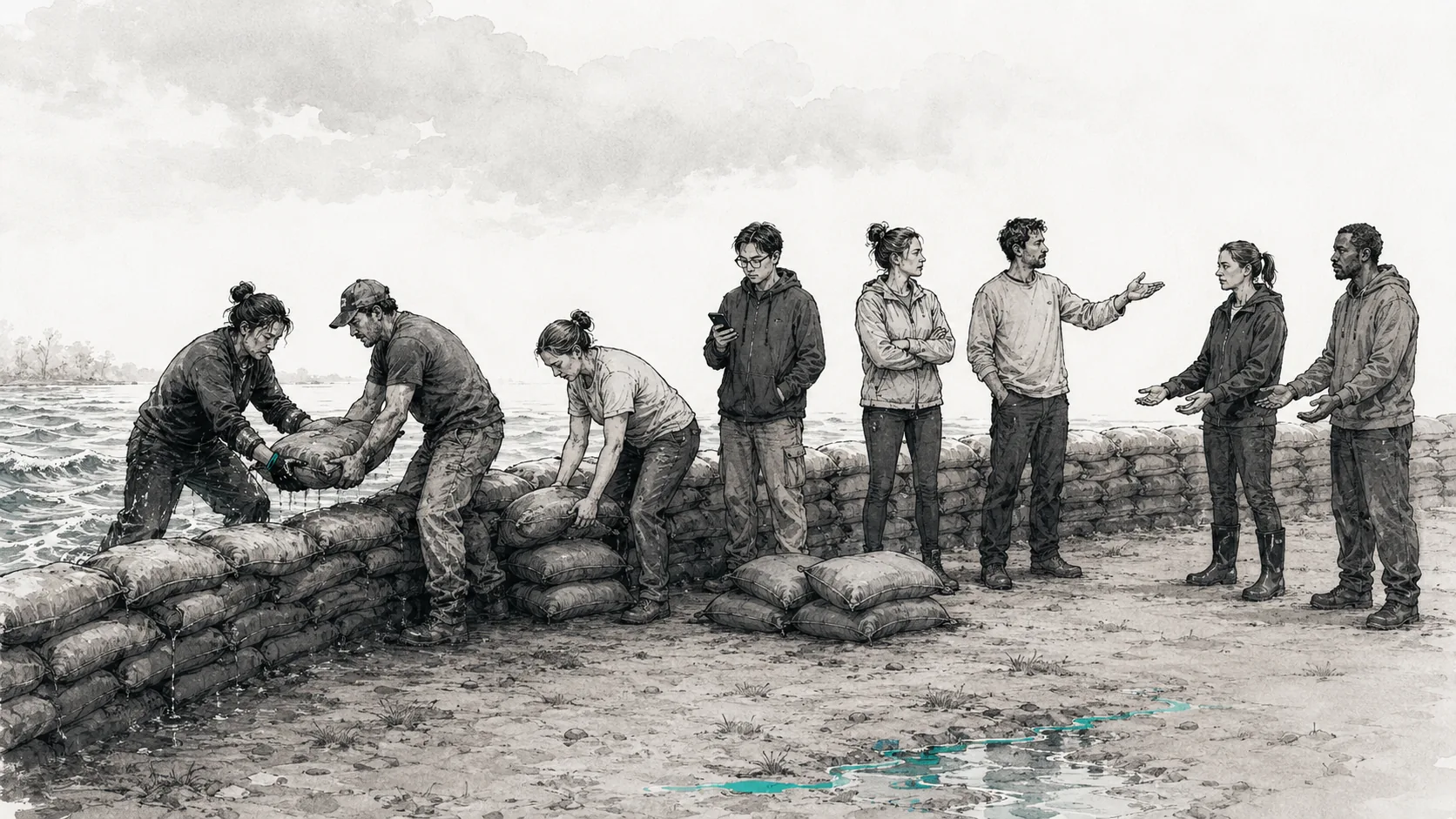
In the organizations I have worked in and around, I have repeatedly met the same pattern: highly visible, fully booked, producing almost nothing. What that pattern costs does not show up on the payroll.
They are in every meeting. They reply fast. They use the right words. Their calendar reads like a national emergency organized by Outlook. From two levels up, they look indistinguishable from the people who hold the real work together. From two desks away, everyone knows exactly who they are.
The problem is not just that they produce little. That would be easy to measure, easy to discuss, and in any half-healthy organization, easy to correct. The more expensive problem is different: when someone does not deliver, the work does not disappear. It migrates.
It migrates toward the same people, every time.
Toward whoever fixes the deliverable before the customer sees it. Toward whoever rewrites the analysis because the columns were wrong. Toward whoever picks up the half-finished ticket, fills in the gaps, reconstructs the context, and still has to smile in the follow-up meeting as if that were collaboration and not operational rescue with better manners.
That is the real cost of tolerated low contribution. It is not the payroll. The payroll is just the visible receipt. The real cost is the silent tax the organization charges its best people for not wanting to make the worst ones uncomfortable.
And that tax does not show up on a P&L. It shows up in the eyes of your best employees six months before they resign.
Presence is not production
Modern work has confused being available with being valuable. A green dot in Teams is not an output. A 96 percent calendar utilization rate is not an output. “Owning the meeting cadence” is not an output. Saying “let me take this back and socialize it with the team” is not an output – it is the precise opposite: a placeholder that converts a decision into a follow-up.
Professional busy people speak this language fluently. They are present without being responsible. They are visible without being accountable. They feed the appearance of work: meetings, channels, documents that circulate for weeks, and conversations that produce follow-ups but not decisions. Because most large organizations measure activity far more easily than they measure outcomes, the appearance is what gets seen.
When presence becomes the unit of contribution, the people who do the most work are penalized by definition. Real work requires uninterrupted blocks, focused attention, and an unwillingness to attend every meeting that is sent. Looking busy is the opposite. It is optimized for visibility.
The work doesn’t disappear. It migrates.
Unfinished, sloppy, late, or wrong-direction work does not vanish when the person responsible for it underdelivers. It is transferred. Quietly, without ceremony, to the same five or six people – the ones who can be relied on to fix it before a customer, a board member, a regulator, or a CEO notices.
In the teams I have observed carrying meaningful business outcomes, I have often found a small inner ring doing a disproportionate share of the real load. They are the ones who catch the half-written ticket and complete it. They are the ones who rewrite the analysis that came back with the columns mislabeled. They are the ones who, when a senior stakeholder asks a hard question in a meeting, are silently looked at by three other people in the room because everyone knows who actually understands the answer.
This redistribution is invisible to upper management for a simple reason: it works. The deadline is met. The customer is served. The quarterly target lands. The board deck looks fine. Nothing in the reported metrics tells you that the same six people absorbed the workload of fifteen. Until those six people quit. Then it tells you everything.
In some departures I have watched, the exit interview is not the whole answer. It may say “new opportunity,” “family considerations,” or “better fit.” A more candid answer may have been spoken to a friend six months earlier: “I’m tired of doing my job and other people’s.” What follows can be surprise, then frustration, then resignation. By the time it reaches resignation, the decision may already have been made internally. You are no longer retaining that person; you are renting them month-to-month until they find a better lease.
The worst part is that this resentment is not loud. Some high performers I have seen do not complain twice. They complain once, observe whether anything changes, and then go quiet. Silence from a top performer is not necessarily contentment. It may be a countdown.
What you tolerate is what you teach
Thesis. In the teams I have watched, a pattern of tolerated low contribution has rarely remained an employee problem. Once managers can see the gap and keep routing its cost elsewhere, it becomes a management problem.
Underperformers exist in every system. That is unremarkable. What is remarkable – and what is fixable – is whether the system distinguishes between contribution and busyness, and what it does when it sees the difference.
When managers cannot or will not make the distinction, three things happen, all of them predictable. First, evaluation becomes a function of visibility rather than impact, because visibility is the only signal that survives upward translation through three layers of organizational distance. Second, the highest-impact employees – who are the least visible because they are heads-down doing the actual work – become statistically underrated relative to their loudest peers. Third, the organization teaches itself, every quarter, that what is rewarded is the appearance of work, not its result. People are not stupid. They respond to the actual incentive structure, not the one written on the wall in the lobby.
Cultures are not built by speeches. They are built by what is tolerated for long enough to become normal. If a senior employee can spend a year producing nothing any peer would describe as material, and that year ends with another vague performance review and no consequence, the organization has not made a personnel decision. It has made a cultural decision. It has communicated to everyone in earshot that the floor for staying employed at this company is very low – and that the relationship between effort and outcome is much weaker than the company’s stated values suggest.
The downstream effects are not hypothetical. They show up in operating metrics every executive team already tracks, just not attributed to a shared underlying cause:
- Cycle times stretch. Decisions that should take days take weeks because the person nominally accountable cannot or will not move them forward.
- Quality degrades. Work is shipped that no one is proud of, because the alternative is shipping nothing.
- Rework climbs. What gets delivered on the first pass increasingly needs a second, third, or fourth.
- Commitments hollow out. Meetings produce alignment without commitment; commitments produce updates without delivery.
- Cross-functional trust erodes. Other departments learn which names mean “this will happen” and which names mean “I will have to do this myself if I want it to happen.”
- Hiring gets harder. Strong candidates talk to your current employees during the interview process, and your current employees tell them the truth.
None of these line items will appear on a deck titled “impact of tolerated underperformance.” They will appear as separate concerns, each with its own working group, each with its own initiative. The root cause connecting them is not named.
It is tempting to believe that organizations fail because of strategic misjudgment, missed market shifts, or external shocks. Some do. Many do not fail all at once; they decay. They decay because too many people are allowed, for too long, to extract value from the system without putting any back. The decay is not dramatic. There is no inflection point you can label on a chart.
It is the slow accumulation of meetings that produced nothing, projects that were almost ready for six quarters, ownership that was shared and therefore exercised by no one, and capable people who eventually concluded that their effort was being converted into someone else’s plausible deniability. Companies in this state can survive a long time, especially with a strong product or a generous market. But surviving is not the same as performing. Every organization in this state is insolvent on talent – consuming the discretionary effort of its best people faster than it is renewing it.
What healthy organizations do differently
The fix is not a culture deck. It is not an offsite. It is not a values refresh. It is a small number of operating disciplines, applied consistently over time, that distinguish contribution from busyness and act on the distinction – and the willingness to treat the hard conversations they require as ordinary leadership work rather than drama. Avoiding those conversations is not respect for the person being avoided; it is disrespect for everyone else on the team.
- Measure outcomes, not visibility Define, for every role, what the person is accountable for producing – not attending. If a role cannot be described in those terms, the role is the problem before the person is. Promotion and compensation decisions should follow the same rule: defensible in a sentence that names a specific outcome. “They are very engaged” is not such a sentence. Neither is “they’re in every room.”
- Make ownership explicit and singular Shared ownership is unowned. For every meaningful deliverable, one name is accountable; everyone else is, at most, contributing.
- Address underperformance early, specifically, and privately A dated, written conversation about a specific gap with a specific expectation and a specific window is more humane than six months of vague feedback followed by a sudden termination. Avoiding the early conversation is not kindness; it is deferred cruelty paid for by the high performers next to that person.
- Protect your high performers from becoming the cleanup crew When a deliverable falls through, do not silently route it to whoever will catch it. Name the failure, fix the root cause, and reset the expectation.
Every executive team eventually makes a quiet decision, without realizing it. The decision is who, inside the organization, will bear the cost of mediocrity. There are only two answers. Either the organization absorbs the cost, by addressing it directly with the discomfort and leadership work that requires; or the high performers absorb the cost, by quietly carrying weight that was never theirs to carry until they decide they have carried it long enough and leave.
The only variable is who pays. The companies that get this right are not crueler than the ones that don’t. They are clearer. They have decided, as a matter of operating principle, that protecting the people who do the work is not optional – and that the comfort of avoiding hard conversations is not worth the slow erosion of the team that built the company in the first place.
Key takeaway. Tolerated low contribution is never free. Someone always pays for it. If the organization does not confront it clearly, the bill migrates to the people who actually deliver: the five or six names everyone trusts when something really matters.
The companies that retain their best people are not simply the ones that pay more or offer better perks. They are the ones that distinguish presence from contribution early – and act before the invisible tax becomes silent resignation.
Source notes
- Gallup, “State of the Global Workplace” (2024). Provides context for the scale of disengagement: Gallup reports roughly 62 percent of employees as “not engaged” and 15 percent as “actively disengaged,” with low engagement associated with an estimated $8.9 trillion in lost global GDP. Those categories are not the same as this essay’s “professional busy people,” and the report does not establish that category. I use it only to show the broader management context in which visible activity and contribution can become disconnected. Source: Gallup, “State of the Global Workplace: 2024 Report”.
- MIT Sloan Management Review – Sull, Sull & Zweig, “Toxic Culture Is Driving the Great Resignation” (Jan 2022). Their analysis of 1.4 million Glassdoor reviews found toxic culture to be a much stronger predictor of attrition than compensation in the studied period. The research concerns attrition and toxic culture, not a measured class of low-output employees. It contextualizes the retention cost of perceived unfairness and management inaction around harmful conduct. Source: Sull, Sull & Zweig, MIT Sloan Management Review (January 11, 2022).
- McKinsey, “Great Attrition or Great Attraction? The Choice Is Yours” (2021). McKinsey’s survey found a gap between employers’ and employees’ accounts of why people leave: employers emphasized compensation and transactional factors, while employees more often cited relational factors such as uncaring leaders and lack of belonging. The study did not test exit interviews or prove that management explains every departure. It helps contextualize why an official account can miss the experience a departing employee describes privately. Source: De Smet, Dowling, Mugayar-Baldocchi & Schaninger, McKinsey Quarterly (September 8, 2021).
- Robert I. Sutton, The No Asshole Rule (Business Plus, 2007) and related writing. Sutton’s work examines the organizational costs surrounding tolerated toxic behavior, including turnover, distraction, and harm to peers. Toxic behavior and quiet under-contribution are different categories. I use his cost-accounting lens by analogy: the salary attached to one person does not capture the burden others absorb around tolerated conduct. Source: Robert I. Sutton’s author site.
- Gallup, “State of the American Manager” (2015) and follow-up research. Gallup reports that managers account for at least 70 percent of the variance in employee engagement scores across business units. That statistic concerns engagement variance, not direct proof that a manager caused a particular employee’s output or departure. It supports the narrower claim that management practice materially shapes the environment in which contribution, recognition, and retention are experienced. Source: Gallup, “State of the American Manager: Analytics and Advice for Leaders”.
Discuss this article
Thoughtful comments, corrections, and notes from real-world practice are welcome. Discussion is managed through GitHub.
This space is intended for meaningful technical discussion, useful corrections, and field experience. Spam, personal attacks, low-effort comments, and vendor pitches may be removed.